The Tunbridge Wells War Memorial was dedicated on 11 February 1923. The memorial is in a prominent position in the main street near the town hall, library and museum.
The names of 801 servicemen who died serving their country during the First World War are inscribed on plaques on the memorial wall. A further 171 names of those who died during the Second World War are entered on additional plaques.
Further information:
Imperial War Museum Tunbridge Wells
Find a Grave - Tunbridge Wells Town War Memorial
Roll of Honour Kent - Tunbridge Wells
War Memorials Online - Tunbridge Wells
British Listed Buildings - Tunbridge Wells War Memorial
Showing posts with label Memorials. Show all posts
Wednesday, 7 November 2018
Tunbridge Wells War Memorial
Labels:
England,
Memorials,
Memorials 2018,
Tunbridge Wells,
World War I,
World War II
Sutton War Memorial
The Sutton War Memorial was dedicated on 26 June 1921 in memory of the 518 servicemen and one women from the area who died during the First World War.
In January 1921 four acres of land was set aside as a memorial park where the memorial is now situated. Plaques containing the names of the fallen are on the sides of the memorial. There is also an inscription to the memory of those who died defending their country during World War II.
Further information:
Historic England - Sutton War Memorial
Imperial War Museum - Sutton War Museum
War Memorials Online - Sutton
In January 1921 four acres of land was set aside as a memorial park where the memorial is now situated. Plaques containing the names of the fallen are on the sides of the memorial. There is also an inscription to the memory of those who died defending their country during World War II.
Further information:
Historic England - Sutton War Memorial
Imperial War Museum - Sutton War Museum
War Memorials Online - Sutton
Labels:
England,
Memorials,
Memorials 2018,
Sutton,
World War I,
World War II
Tuesday, 6 November 2018
Crawley memorials
A memorial to those who died in World War I is situated in front of St John's Church in Crawley.
The memorial commemorates the residents of Crawley who were killed or went missing in World War I (34 names) and World War II (19 servicemen and 9 civilians). On several occasions during 1943 and 1944 doodlebugs were dropped on the small community of Crawley resulting in the deaths of nine civilians plus another sixty-nine people injured.
The Crawley Memorial Gardens were established in 1921 when money was raised by public subscription to purchased the required land.
Gates at the park entrance near the County Mall shopping centre contain rolls of honour - lists of the names of those from the area who died during two world wars.
In 2014 the main path through the gardens was established as the Heroes' Walk as part of the commemorations for the Centenary of the First World War. Rows of flowers were planted from seed along each side of the path and display boards provide information about what was happening during the war one hundred years ago. When we were there the focus was on the last few months of the war leading to the Armistice.
Further information:
Traces of War - Crawley
Traces of War - Crawley Memorial Park
Looking Back at Doodlebug Days of World War Two - Crawley and Horley Observer 18 May 2016
Floral Displays Fit for Heroes - CHT News Online 25 July 2015
Memorial Gardens - Crawley Borough Council
Roll of Honour - Crawley War Memorial
The memorial commemorates the residents of Crawley who were killed or went missing in World War I (34 names) and World War II (19 servicemen and 9 civilians). On several occasions during 1943 and 1944 doodlebugs were dropped on the small community of Crawley resulting in the deaths of nine civilians plus another sixty-nine people injured.
The Crawley Memorial Gardens were established in 1921 when money was raised by public subscription to purchased the required land.
| Photo from Flickr |
In 2014 the main path through the gardens was established as the Heroes' Walk as part of the commemorations for the Centenary of the First World War. Rows of flowers were planted from seed along each side of the path and display boards provide information about what was happening during the war one hundred years ago. When we were there the focus was on the last few months of the war leading to the Armistice.
Further information:
Traces of War - Crawley
Traces of War - Crawley Memorial Park
Looking Back at Doodlebug Days of World War Two - Crawley and Horley Observer 18 May 2016
Floral Displays Fit for Heroes - CHT News Online 25 July 2015
Memorial Gardens - Crawley Borough Council
Roll of Honour - Crawley War Memorial
Labels:
Crawley,
England,
Memorials,
Memorials 2018,
World War I,
World War II
Horsham War Memorial
The Horsham War Memorial was dedicated on 13 November 1921. The memorial commemorates and names the residents of Horsham who served and died during World War I (359) and World War II (119).
The names have been inscribed on the panels on the semi-circular wall behind the monument.
Near the cricket ground and the church is the Garden of Remembrance.
It was established to remember those who died while serving their country during World War I.
The peaceful garden contains this memorial stone.
Further information:
Imperial War Museum - Memorials
Traces of War - Horsham
The names have been inscribed on the panels on the semi-circular wall behind the monument.
Near the cricket ground and the church is the Garden of Remembrance.
It was established to remember those who died while serving their country during World War I.
The peaceful garden contains this memorial stone.
Further information:
Imperial War Museum - Memorials
Traces of War - Horsham
Labels:
England,
Horsham,
Memorials,
Memorials 2018,
World War I,
World War II
Abergavenny war memorials
Walking into Abergavenny from the cricket ground, the memorial to the 3rd Battalion Monmouthshire Regiment stands looking down the main street.
It honours the men from the regiment who died during the First World War and the Second World War.
The Abergavenny Market Hall holds the war memorial for the district.
The white marble honour board lists the 276 names of men from the region who died during the First World War. (War Memorials Online)
Nearby is a framed plaque erected by the employees in the Locomotive Department London & North Western Railway, Abergavenny and Sub-Station in memory of their fellow workmen who lost their lives in the Great War 1914-1918. (Military images) Two names of servicemen who died during the Second World War have been added.
Also in the hall is a list of the names of those from the area who died during the Second World War and Afghanistan. (War Memorials Online)
Further information:
Lost Ancestors - Abergavenny
War Memorials Online - Abergavenny and District
History Points - Abergavenny memorials
Imperial War Museum - Abergavenny
Military Images - Abergavenny Railway
It honours the men from the regiment who died during the First World War and the Second World War.
The Abergavenny Market Hall holds the war memorial for the district.
The white marble honour board lists the 276 names of men from the region who died during the First World War. (War Memorials Online)
Nearby is a framed plaque erected by the employees in the Locomotive Department London & North Western Railway, Abergavenny and Sub-Station in memory of their fellow workmen who lost their lives in the Great War 1914-1918. (Military images) Two names of servicemen who died during the Second World War have been added.
Also in the hall is a list of the names of those from the area who died during the Second World War and Afghanistan. (War Memorials Online)
Further information:
Lost Ancestors - Abergavenny
War Memorials Online - Abergavenny and District
History Points - Abergavenny memorials
Imperial War Museum - Abergavenny
Military Images - Abergavenny Railway
Labels:
Abergavenny,
Memorials,
Memorials 2018,
Wales,
World War I,
World War II
Cirencester War Memorial
The Cirencester War Memorial stands in Market Place outside the Church of St John the Baptist. It was dedicated on 31 October 1918.
The memorial commemorates those from the region who died serving in the First World War (210) and the Second World War.
A list of names of those who died serving in the two wars is inscribed on the west face of the south porch of the church.
When we visited the Church of St John the Baptist in June 2015 a section of the church was set aside for recording the history of the First World War.
The period covered on this board was April to June 1915.
When we returned in August 2018 the events occurring in the second half of the year were recorded.
The above notice informs one group of soldiers at the Front of the Cease Fire at 11.am that day. They are instructed to 'Form up and march back independently to the Chateau Harveng at once. Do not forget to bring the canteen with you.' Chateau d'Harveng is in Mons.
While we were at the church a lady was working on a display of knitted and crocheted poppies to be used as part of the commemorative service remembering the declaration of the end of the war on the 11 November 2018.
War Memorials Online Cirencester Cross
Historic England Cirencester War Memorial
CAHS - Cirencester War Memorials
The memorial commemorates those from the region who died serving in the First World War (210) and the Second World War.
A list of names of those who died serving in the two wars is inscribed on the west face of the south porch of the church.
When we visited the Church of St John the Baptist in June 2015 a section of the church was set aside for recording the history of the First World War.
The period covered on this board was April to June 1915.
When we returned in August 2018 the events occurring in the second half of the year were recorded.
The above notice informs one group of soldiers at the Front of the Cease Fire at 11.am that day. They are instructed to 'Form up and march back independently to the Chateau Harveng at once. Do not forget to bring the canteen with you.' Chateau d'Harveng is in Mons.
While we were at the church a lady was working on a display of knitted and crocheted poppies to be used as part of the commemorative service remembering the declaration of the end of the war on the 11 November 2018.
War Memorials Online Cirencester Cross
Historic England Cirencester War Memorial
CAHS - Cirencester War Memorials
Labels:
Cirencester,
England,
Memorials,
Memorials 2018,
Poppies,
World War I,
World War II
Monday, 5 November 2018
Pershore War Memorial
The Pershore War Memorial is situated within Pershore Abbey. The memorial was dedicated on 1 November 1921.
The memorial is dedicated to soldiers from the area who died during the First World War (101) and the Second World War (24). The figure on the top of the plinth is Winged Victory.
Further information:
Imperial War Museum Memorials
War Memorials Online Pershore War Memorial
The memorial is dedicated to soldiers from the area who died during the First World War (101) and the Second World War (24). The figure on the top of the plinth is Winged Victory.
Further information:
Imperial War Museum Memorials
War Memorials Online Pershore War Memorial
Labels:
England,
Memorials,
Memorials 2018,
Pershore,
World War I,
World War II
Kings Lynn War Memorial
The Kings Lynn War Memorial stands in Tower Park and was unveiled on 26 January 1921.
The memorial commemorates the 563 men from the area who died during the First World War and 19 from the Second World War.
Further information:
Imperial War Museum Memorials Register
War Memorials Online Kings Lynn Memorial
The memorial commemorates the 563 men from the area who died during the First World War and 19 from the Second World War.
Further information:
Imperial War Museum Memorials Register
War Memorials Online Kings Lynn Memorial
Labels:
England,
Kings Lynn,
Memorials,
Memorials 2018,
World War I,
World War II
Maldon War Memorial
In High Street, Maldon, outside All Saints Church stands the Maldon War Memorial. Subscriptions were collected from 1919 to build amemorial to commemorate those who men from Maldon and Heybridge who died serving their country. The memorial was dedicated on 8 May 1921.
The memorial commemorates those who died in the First World War (146) and the Second World War (42).
Further information:
Imperial War Museum Memorials
War Memorials Online Waldon War Memorial
The memorial commemorates those who died in the First World War (146) and the Second World War (42).
Further information:
Imperial War Museum Memorials
War Memorials Online Waldon War Memorial
Labels:
England,
Maldon,
Memorials,
Memorials 2018,
World War I,
World War II
Saturday, 3 November 2018
Centenary of the Great War - Tring
The Tring War Memorial was dedicated on the 27 November 1918. It commemorates the 110 men from the area who died during the First World War and the 33 men who died during the Second World War.
The memorial is in the grounds of the Church of St Peter and St Paul in High Street.
Tring also has another area commemorating those who served and died during war. The Memorial Gardens which were established in memory of soldiers from the area who died during the Second World War.
The gardens had special displays commemorating the centenary of the First World War.
The flower beds in High Street near the entrance gates are regularly replanted.
The gardens are fenced and entrance is through gates with plaques on the pillars listing the names of soldiers who died during the Second World War.
Displays on this board are changed periodically. The centenary of the Battle of Passchendaele was being commemorated at the end of July.
The gardens are a peaceful place to relax and reflect as well as remember those who have died serving their country.
Further information:
Imperial War Museum Memorial
Imperial War Museum WWII Memorial
The Memorial Garden, Tring
The memorial is in the grounds of the Church of St Peter and St Paul in High Street.
Tring also has another area commemorating those who served and died during war. The Memorial Gardens which were established in memory of soldiers from the area who died during the Second World War.
The gardens had special displays commemorating the centenary of the First World War.
The flower beds in High Street near the entrance gates are regularly replanted.
The gardens are fenced and entrance is through gates with plaques on the pillars listing the names of soldiers who died during the Second World War.
Displays on this board are changed periodically. The centenary of the Battle of Passchendaele was being commemorated at the end of July.
The gardens are a peaceful place to relax and reflect as well as remember those who have died serving their country.
Further information:
Imperial War Museum Memorial
Imperial War Museum WWII Memorial
The Memorial Garden, Tring
Labels:
England,
Memorials,
Memorials 2018,
Tring,
World War I,
World War II
Sunday, 26 November 2017
Diggers Bistro at Comfort Inn, Anzac Highway, Glenelg
The 1st Australian Veterans Over 70s Cricket Championships was held in Adelaide from 4 - 9 November 2017.
Many members of Victorian teams stayed at the Comfort Inn on Anzac Highway, Glenelg. The motel is within easy walking distance to the shops and Glenelg Beach.
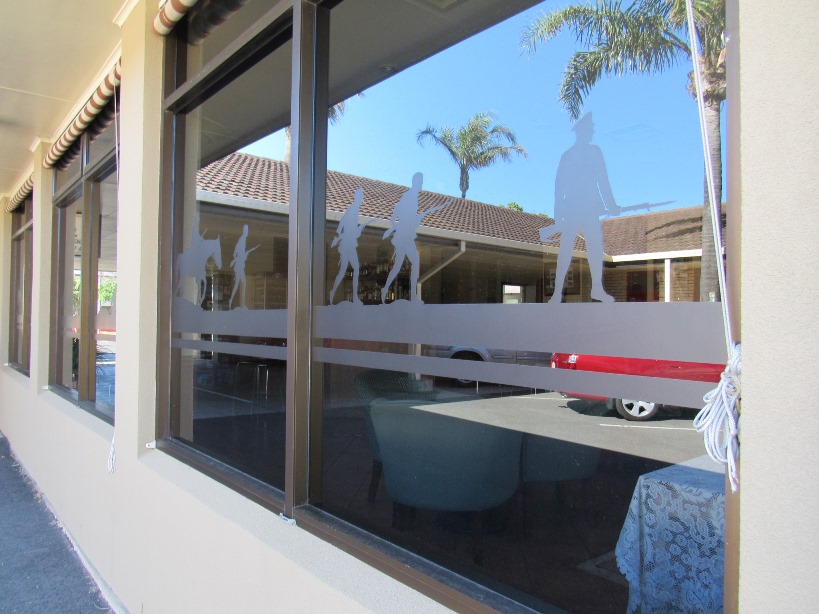
The Diggers Bistro, at the motel, keeps with the Anzac theme with stencils depicting scenes from the First World War on the windows.
Inside are war related images such as this coloured glass depiction of men on horseback. This is one of a pair of coloured glass images hanging on the back wall of the restaurant.
One of the walls has a pair of framed prints including this one of the cliffs at Anzac Cove.
A collection of Anzac biscuit tins and Anzac memorabilia is displayed on a cabinet.
Most of our evening meals were at the motel.
Many members of Victorian teams stayed at the Comfort Inn on Anzac Highway, Glenelg. The motel is within easy walking distance to the shops and Glenelg Beach.
The Diggers Bistro, at the motel, keeps with the Anzac theme with stencils depicting scenes from the First World War on the windows.
Inside are war related images such as this coloured glass depiction of men on horseback. This is one of a pair of coloured glass images hanging on the back wall of the restaurant.
One of the walls has a pair of framed prints including this one of the cliffs at Anzac Cove.
A collection of Anzac biscuit tins and Anzac memorabilia is displayed on a cabinet.
Most of our evening meals were at the motel.
Tuesday, 30 May 2017
London remembers
Bronze relief created by Paul Day depicting King George VI and Queen Elizabeth visiting Londoners bombed out during the Second World War. The relief is on a wall in The Mall in London next to a statue of Queen Elizabeth, the Queen Mother. It was unveiled in February 2009.
The King and Queen had refused to leave London during The Blitz. The relif shows another aspect of the war in London.
London Remembers website
The King and Queen had refused to leave London during The Blitz. The relif shows another aspect of the war in London.
London Remembers website
Battle of Britain
The Battle of Britain monument in London on the Victoria Embankment near the River Thames was unveiled by Prince Charles on 18 September 2005. The monument was devised by the Battle of Britain Historical Society. Paul Day was the sculptor.
The monument commemorates all those who took part in the battle - the airmen and the civilians.
'Never in the field of human conflict was so much owed by so many to so few' - Winston Churchill.
For more detailed information about, and description of, this monument see The Battle of Britain London Monument website.
The monument commemorates all those who took part in the battle - the airmen and the civilians.
'Never in the field of human conflict was so much owed by so many to so few' - Winston Churchill.
For more detailed information about, and description of, this monument see The Battle of Britain London Monument website.
Monday, 29 May 2017
London air-raids 1917
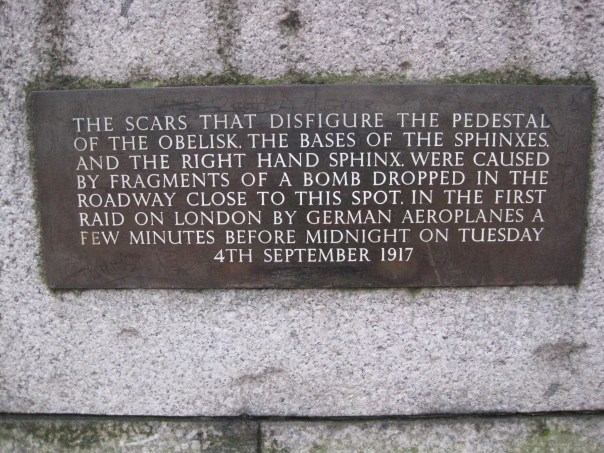
This plaque is found along the banks of the Thames River in London.
The Sphinx on the banks of the Thames River was presented to England by Egypt in 1819 as a memorial to Lord Nelson and Sir Ralph Abercromby and the battles against Napoleon in Egypt, particularly in 1798. The sphinx was one of the landmarks slightly damaged during the bombing of London. However many buildings were destroyed in the air-raids and people killed.
Websites
1914-1918 Online - International Encyclopedia of the First World War - Bombing of London
History in the Headlines - London's World War / Zeppelin Terror
Imperial War Museum - Air raids that shook London in the First World War
The Sphinx on the banks of the Thames River was presented to England by Egypt in 1819 as a memorial to Lord Nelson and Sir Ralph Abercromby and the battles against Napoleon in Egypt, particularly in 1798. The sphinx was one of the landmarks slightly damaged during the bombing of London. However many buildings were destroyed in the air-raids and people killed.
Websites
1914-1918 Online - International Encyclopedia of the First World War - Bombing of London
History in the Headlines - London's World War / Zeppelin Terror
Imperial War Museum - Air raids that shook London in the First World War
Shoes of the Danube
| In memory of the victims shot into the Danube in 1944-45 |
When we visited Budapest in July 2011 there was an exhibiton entitled The Stones of the Embankment which included this panel. The wording on the panel read:
In the darkest period of our history the banks of the Danube turned into the site of mass killings. The members of the Arrow Cross Party (the Hungarian Nazis) shot hundreds of people and dropped them in the Danube. Their memory is preserved by sixty pairs of iron shoes on the Danube River bank, a work by Gyula Pauer.It is a moving memorial.
Website
Visit Budapest - Shoes of the Danube
Tuesday, 23 May 2017
Shire of Nunawading Honour Board
In 1920 the decision was made to have an honour board created that would have inscribed the names of those from the district who had enlisted for service during the First World War. The honour board was to be displayed in the Shire Hall at Box Hill.
The honour board was designed by H Goldman Manufacturing Company, furniture-makers, who had worked on similar projects. The cost of the project was to be no more than £250. Up to 600 names were to be recorded on the honour board.
There was some discussion as to the names to be included on the board. The plan was that the names of all volunteers from the district were to be inscribed on the board however, as with a number of other memorial projects, names were omitted.
Staff Nurse J M Gaff was the only woman whose name appeared on the honour board.
Steven Cooke in his book, The Sweetland Project, notes that "Nurses Clarice Daley and Harriet and Muriel Mawson would be missing from the list of those who served, although Nurse Jenny Gaff would be included." (p 132)
It is interesting then to try and reflect why Janet Muir Gaff's name was included and the names of the other nurses were omitted.
Janet Gaff and her family settled in Blackburn in the early 1890s after migrating to Australia from Scotland in 1891. The family home was Archernar, Gordon Crescent, Blackburn. Janet's mother was Marion Currie Steele who lived in the house with daughters Helen Mary and Marion Margaret. Her son Archibald William (and later his wife Frances) lived with the family for many years. From 1909 another son, John Shaw Steele, also lived in the family home until his death in 1927. James McLean Steel,another son, lived in Box Hill until his death in 1909. Prior to the war Janet spent most of her time nursing in western Victoria, however the house in Blackburn was still used as her base and she returned to live there with her sisters when she returned from England in 1919.
When Marion Currie Steel died on 7 August 1914 a detailed obituary appeared in the Box Hill Reporter 14 August 1914 p 5 including the passages - "she was a familiar figure in her phaeton to regular users of Whitehorse and Canterbury roads" and "Mrs Steel was a lady of a fine intellectual type, being a great reader and student of Biblical and Jewish history and classical literature, and was keenly delighted to discuss these subjects. She also took a great interest in flowers and in her garden."
Blackburn was a small community early in the twentieth century. The Victorian Municipal Directory for 1911 describes Blackburn as "On creek with the same name, hotel, public hall, state school, and three churches. Poultry farming, gardening and fruit growing. Population 1040." (p 549) By 1916 the population had grown to 1,228. The entry read "rising township, with post, telegraph and telephone offices, hotel, state school, three churches, public hall, tennis courts, sports grounds, lake and park. Lit by electricity. Residential and fruit growing district." (p 556)
It can therefore be surmised that by the time of the war the Steel family was well known in a growing local community.
Another name on the honour board is that of John Shaw Steel, Janet's brother. John was an analytical chemist who applied to enlist in the army in 1916 but was discharged at the request of the Minister of Munitions and was transferred to the Engineer Service.
Janet enlisted in the AANS in August 1915 and after nursing for a year at the No 5 AGH in St Kilda Road she enlisted as a nurse in the No 4 Sea Transport Service working aboard troop ships travelling between Australia and England. She also worked in Australian Auxiliary hospitals in England until the end of the war.
Therefore Janet's strong family connections with the Blackburn area before and after the war, including her living in the area, her three and a half years spent nursing Australian soldiers as well as having a brother whose name was included on the board for his war service all possibly contributed to Janet's name being included on the Shire of Nunawading honour board.
Steven Cooke mentioned that the names of three other nurses from area were omitted from the honour board.
One of the names was that of Clarice Jessie Daley who was born in Box Hill in 1889. Clarice's father, John, was a builder and the according to the electoral rolls the family lived in other locations before the war including Bendigo (1906) and later Elsternwick. In 1912 Clarice is shown as being a nurse at the Melbourne Hospital. On 18 May 1915 Clarice was aboard a ship on her way to Lemnos where she nursed soldiers wounded during the Gallipoli campaign. On 21 October 1915 Clarice married Sergeant Ernest Lawrence. Clarice returned to Australia on 9 February as married nurses were not allowed to serve overseas. She was discharged from the army on 31 July 1916. Clarice, however appears to have continued working as a nurse as the 1919 electoral roll shows that she was a nurse at Base Hospital St Kilda Road. A detailed article about Clarice can be found on the City of Port Phillip Heritage website.
The other two names mentioned by Steven Cooke were of sisters Harriet Godden Mawson and Muriel Mawson. Harriet was born in Kensington in 1885 while Muriel was born in Carlton in 1889. The electoral rolls show that the girls' father, Frederick William Mawson, lived at Surrey Hills. The girls would have lived at the family home in Surrey Hills when they were young, however the 1914 electoral roll shows that Harriet was a nurse at Hamilton while the electoral roll for 1915 shows Muriel nursing at Castlemaine. Harriet enlisted 27 April 1917 and sailed for England on 9 May where she worked in a number of military hospitals. Muriel enlisted on 11 April 1917 and sailed for England in May. She also worked at military hospitals in England. Both Harriet and Muriel returned to Australia on 15 March 1919 and were discharged in July. Both the sisters continued working as nurses for many years. Australian Nurses in World War I website provides information about both of these nurses and also of their older sister Beatrice. Beatrice Mary Mawson, was born in England in 1881 and was also a nurse. Beatrice was nursing at Castlemaine before joining the British nursing service on 14 May 1915. She worked at the British hospital at Alexandria and later worked on transport ships sailing between Le Havre and England, making 23 trips. When Captain Mawson returned to Australia in June 1917, following the death of her father, the ship hit a mine near Bombay. Beatrice Mawson continued her nursing career in Australia.
It is not possible to know for certain why the names of these nurses were not included on the Shire of Nunawading honour board - one can only make an educated guess.
In Clarice's case, the family appear to have moved from the area when she was young, so it is possible that her connection with Box Hill was not widely known.
Muriel, Harriet and Beatrice, however, did have a war-time family connection to Surrey Hills and would have lived in the area when they were young. Beatrice was listed on the electoral roll at the Surrey Hills address in 1903. Harriet, according to the the 1919 electoral roll, was in Surrey Hills immediately after the war but then moved closer to the hospitals where she worked. As their father had died in 1917 and the girls were nursing out of the area, their war service with a connection to the local area was possibly overlooked.
References
Cooke, Steven. The Sweetland Project: Remembering Gallipoli in the Shire of Nunawading. North Melbourne: Australian Scholarly, 2005
Victorian Municipal Directory 1911 and 1916
Australian Nurses in World War I website
The honour board was designed by H Goldman Manufacturing Company, furniture-makers, who had worked on similar projects. The cost of the project was to be no more than £250. Up to 600 names were to be recorded on the honour board.
![]() |
| Honour Board in Box Hill Town Hall foyer - Photo taken 4 December 2009 |
Staff Nurse J M Gaff was the only woman whose name appeared on the honour board.
Steven Cooke in his book, The Sweetland Project, notes that "Nurses Clarice Daley and Harriet and Muriel Mawson would be missing from the list of those who served, although Nurse Jenny Gaff would be included." (p 132)
It is interesting then to try and reflect why Janet Muir Gaff's name was included and the names of the other nurses were omitted.
Janet Gaff and her family settled in Blackburn in the early 1890s after migrating to Australia from Scotland in 1891. The family home was Archernar, Gordon Crescent, Blackburn. Janet's mother was Marion Currie Steele who lived in the house with daughters Helen Mary and Marion Margaret. Her son Archibald William (and later his wife Frances) lived with the family for many years. From 1909 another son, John Shaw Steele, also lived in the family home until his death in 1927. James McLean Steel,another son, lived in Box Hill until his death in 1909. Prior to the war Janet spent most of her time nursing in western Victoria, however the house in Blackburn was still used as her base and she returned to live there with her sisters when she returned from England in 1919.
When Marion Currie Steel died on 7 August 1914 a detailed obituary appeared in the Box Hill Reporter 14 August 1914 p 5 including the passages - "she was a familiar figure in her phaeton to regular users of Whitehorse and Canterbury roads" and "Mrs Steel was a lady of a fine intellectual type, being a great reader and student of Biblical and Jewish history and classical literature, and was keenly delighted to discuss these subjects. She also took a great interest in flowers and in her garden."
Blackburn was a small community early in the twentieth century. The Victorian Municipal Directory for 1911 describes Blackburn as "On creek with the same name, hotel, public hall, state school, and three churches. Poultry farming, gardening and fruit growing. Population 1040." (p 549) By 1916 the population had grown to 1,228. The entry read "rising township, with post, telegraph and telephone offices, hotel, state school, three churches, public hall, tennis courts, sports grounds, lake and park. Lit by electricity. Residential and fruit growing district." (p 556)
It can therefore be surmised that by the time of the war the Steel family was well known in a growing local community.
Another name on the honour board is that of John Shaw Steel, Janet's brother. John was an analytical chemist who applied to enlist in the army in 1916 but was discharged at the request of the Minister of Munitions and was transferred to the Engineer Service.
Janet enlisted in the AANS in August 1915 and after nursing for a year at the No 5 AGH in St Kilda Road she enlisted as a nurse in the No 4 Sea Transport Service working aboard troop ships travelling between Australia and England. She also worked in Australian Auxiliary hospitals in England until the end of the war.
Therefore Janet's strong family connections with the Blackburn area before and after the war, including her living in the area, her three and a half years spent nursing Australian soldiers as well as having a brother whose name was included on the board for his war service all possibly contributed to Janet's name being included on the Shire of Nunawading honour board.
Steven Cooke mentioned that the names of three other nurses from area were omitted from the honour board.
One of the names was that of Clarice Jessie Daley who was born in Box Hill in 1889. Clarice's father, John, was a builder and the according to the electoral rolls the family lived in other locations before the war including Bendigo (1906) and later Elsternwick. In 1912 Clarice is shown as being a nurse at the Melbourne Hospital. On 18 May 1915 Clarice was aboard a ship on her way to Lemnos where she nursed soldiers wounded during the Gallipoli campaign. On 21 October 1915 Clarice married Sergeant Ernest Lawrence. Clarice returned to Australia on 9 February as married nurses were not allowed to serve overseas. She was discharged from the army on 31 July 1916. Clarice, however appears to have continued working as a nurse as the 1919 electoral roll shows that she was a nurse at Base Hospital St Kilda Road. A detailed article about Clarice can be found on the City of Port Phillip Heritage website.
The other two names mentioned by Steven Cooke were of sisters Harriet Godden Mawson and Muriel Mawson. Harriet was born in Kensington in 1885 while Muriel was born in Carlton in 1889. The electoral rolls show that the girls' father, Frederick William Mawson, lived at Surrey Hills. The girls would have lived at the family home in Surrey Hills when they were young, however the 1914 electoral roll shows that Harriet was a nurse at Hamilton while the electoral roll for 1915 shows Muriel nursing at Castlemaine. Harriet enlisted 27 April 1917 and sailed for England on 9 May where she worked in a number of military hospitals. Muriel enlisted on 11 April 1917 and sailed for England in May. She also worked at military hospitals in England. Both Harriet and Muriel returned to Australia on 15 March 1919 and were discharged in July. Both the sisters continued working as nurses for many years. Australian Nurses in World War I website provides information about both of these nurses and also of their older sister Beatrice. Beatrice Mary Mawson, was born in England in 1881 and was also a nurse. Beatrice was nursing at Castlemaine before joining the British nursing service on 14 May 1915. She worked at the British hospital at Alexandria and later worked on transport ships sailing between Le Havre and England, making 23 trips. When Captain Mawson returned to Australia in June 1917, following the death of her father, the ship hit a mine near Bombay. Beatrice Mawson continued her nursing career in Australia.
It is not possible to know for certain why the names of these nurses were not included on the Shire of Nunawading honour board - one can only make an educated guess.
In Clarice's case, the family appear to have moved from the area when she was young, so it is possible that her connection with Box Hill was not widely known.
Muriel, Harriet and Beatrice, however, did have a war-time family connection to Surrey Hills and would have lived in the area when they were young. Beatrice was listed on the electoral roll at the Surrey Hills address in 1903. Harriet, according to the the 1919 electoral roll, was in Surrey Hills immediately after the war but then moved closer to the hospitals where she worked. As their father had died in 1917 and the girls were nursing out of the area, their war service with a connection to the local area was possibly overlooked.
References
Cooke, Steven. The Sweetland Project: Remembering Gallipoli in the Shire of Nunawading. North Melbourne: Australian Scholarly, 2005
Victorian Municipal Directory 1911 and 1916
Australian Nurses in World War I website
Thursday, 16 April 2015
Whitehorse Remembers
The Anzac Day display at Nunawading Library this year focuses on some of the memorials to those who served in World War I in what is now the City of Whitehorse.
In conjunction with the Diggers in Whitehorse and Manningham project one of the librarians, Elaine Craig, took a series of photographs of all the memorials she could locate. A selection of the Whitehorse memorials is included in the display.
In the foyer of the Box Hill Town Hall there is a large honour board listing the names of those from the Shire of Nunawading, as the area was then known, who served during the First World War. The centre panel contains the names of those who did not return.
There are a number of official public memorials in the region including the Box Hill War Memorial, now located in the Box Hill Gardens.
Another war memorial is at Morton Park in Blackburn (pictured centre in the above image). The honour board shown on the left is for the Vermont Volunteers. This board was for many years displayed at the Vermont Mechanics Institute. Schools also remembered former pupils and staff who served. Many of the schools had honour rolls which often included information about the military service of students. Honour boards would also be displayed at schools.
Many organisations including churches and businesses also recognised their members who served. Space for the display was limited however the small selection demonstrates a range of memorials in the region. The display also promotes the library's Diggers database containing the names of those who served as well as Whitehorse Heritage Week to be held 10-17 September.
In conjunction with the Diggers in Whitehorse and Manningham project one of the librarians, Elaine Craig, took a series of photographs of all the memorials she could locate. A selection of the Whitehorse memorials is included in the display.
In the foyer of the Box Hill Town Hall there is a large honour board listing the names of those from the Shire of Nunawading, as the area was then known, who served during the First World War. The centre panel contains the names of those who did not return.
There are a number of official public memorials in the region including the Box Hill War Memorial, now located in the Box Hill Gardens.
Another war memorial is at Morton Park in Blackburn (pictured centre in the above image). The honour board shown on the left is for the Vermont Volunteers. This board was for many years displayed at the Vermont Mechanics Institute. Schools also remembered former pupils and staff who served. Many of the schools had honour rolls which often included information about the military service of students. Honour boards would also be displayed at schools.
Many organisations including churches and businesses also recognised their members who served. Space for the display was limited however the small selection demonstrates a range of memorials in the region. The display also promotes the library's Diggers database containing the names of those who served as well as Whitehorse Heritage Week to be held 10-17 September.
Subscribe to:
Posts (Atom)